

News
The latest news from the LEAP program, its Fellows and Mentors, and the broader syn bio community.
03.30.15 Program News
“Technology Doesn’t Sound Like the Problem”
by Sanjana Ravi, Nicola Patron, Ted Fjällman and Karen Ingram: February's LEAP landscaping workshop brought together scholars, innovators, scientists and artists from various levels of academia, government, and industry to explore the...
Read More » | More Program News »
by Sanjana Ravi, Nicola Patron, Ted Fjällman and Karen Ingram:
February's LEAP landscaping workshop brought together scholars, innovators, scientists and artists from various levels of academia, government, and industry to explore the current state of synthetic biology research, policy, and practice.
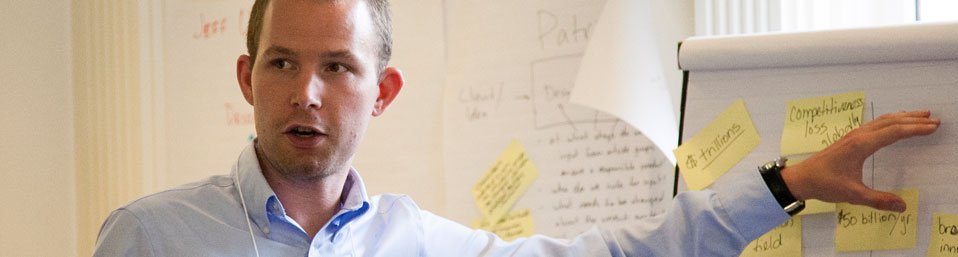
"Technology doesn't sound like the problem." It might have been pre-guaranteed that someone would conclude this after hearing the achievements and future aims of the members this incredibly talented group, which we are humbled to be a part of. While there are still some significant technological leaps to be made, the main impediments to synthetic biology being able to make the world a better place were not thought to lie in the laboratory. Several themes emerged over the course of the workshop that promise to shape the way this year's LEAP fellows consider challenges and opportunities in this space: the need for communication and coordination within the synthetic biology community, useful examples of success to ensure continued investment, effective regulation to mitigate the environmental and security risks of this rapidly advancing and increasingly open technology, and engaging the public to allay fears of new and emerging biotechnologies:
Communication and Coordination: Influencing for the common good
As a community of practitioners, the synthetic biologists in this network have already amassed considerable community social capital. Without exception we wish to contribute to the common good. The future we are aiming for is cleaner, greener, healthier and fairer and yet the dominant themes at the landscaping workshop were what and who would impede the application of this technology and what their motivations might be.
Perhaps this is unsurprising. We are the scientific progeny of the generation of inventors that introduced genetic modification to the world and we operate in that legacy. Additionally, synthetic biology is coming of age in a world where increasing bioliteracy and access to technology comes with the credible risk of enabling those who seek to do harm.
Although the scientists among us are often skeptical, there is a body of evidence informing us that the majority of the public is a long way from being anti-technology. As a community our main concern, and that of policy makers, should not be to force the acceptance of technology but to ensure that research and innovation is aligned with society’s values and needs. A community that has this at its core will automatically receive a public mandate to influence funding, policy and regulation in order to supply solutions.
Lessons can be learned from nanotechnology, which fared far better than GM. The nanotechnology community embraced corporate social responsibility, including mobilising as a community to write a code of conduct for responsible nanosciences and nanotechnologies research. In contrast, the reasons for embracing GM technologies were most often heard from powerful, individual corporations or publicly inaccessible scientific societies.
As a community of emerging leaders we have the opportunity to leverage considerable influence. If we seek to use this influence to advance individual applications of synthetic biology we may be destined to underachieve and the future regulation and policy landscape is unlikely to be conducive to accelerated implementation. If we listen with a collective ear, develop socially responsible practices, engage with international agencies that have a mandate to improve lives, and provide a conduit for information on how synthetic biology can be used to addressed local and global problems, we have the opportunity to be the source of wanted solutions.
Ensuring that Systems Approaches Accelerate Innovation in Synbio
Synthetic Biology needs to prove that its engineering or systems approach to invention actually accelerates the path to innovation compared to more traditional biotechnological techniques. Let us explain why:
Genetic modification is a proven technique that has resulted in countless innovations and saves millions of lives every year. Despite some people's fears, it is generally accepted, especially within healthcare, where most advanced therapies would not be possible without it. But in terms of investment it is nowadays essentially taken for granted. No investor or big company is going to invest in a biotech company purely because it is in the business of 'genetic modification'. Nor will they (soon at least) invest purely on the basis that a company engages in synthetic biology (yes, the CAPS will drop to lower case).
So, how does synthetic biology prove that it is even better than GM and deserves its (currently hyped) label? How do we prove that it represents a step change from the rest of the biotech field? The answer is simple: Prove that it solves problems faster and better than other approaches! Easier said than done. "Better" will always be difficult to prove and we won't go there. "Faster" is actually measurable and thus provides a glimmer of hope that in ten years' time there still will be a "SynBio community."
We envision that the SynBio community, as it stands today, will create an organisation that tracks how quickly companies using synthetic biology can get, for example, drugs, industrial biomaterials or even consumer products to market compared to competing companies that do not apply systematic, engineering principles to biology. In so doing we may be able to prove that when you design an entire pathway in an organism, you route to success is swifter that by "spray and pray" - a term that biotechnologists use for making numerous, indiscriminate changes to a community of biological systems and then picking out any individuals that exhibit favourable traits. The latter is working; the question is can rational design using SynBio engineering principles win the race to innovate faster?
Security, Risk Assessment, and Responsibility in Synbio Innovation and Practice
Numerous horizon-scanning efforts are currently underway among scientists, investors, policymakers, artists, and communicators, aimed at mapping the trajectory of synthetic biological technologies. The security, regulatory, and risk assessment communities are similarly invested in these efforts and are working to ensure that applications of synthetic biology evolve in a safe and responsible manner. Engaging these stakeholders at every step of research, development, and marketing is critical not only to synthetic biology's continued growth, but also for equitable distribution and public acceptance of the products and processes that emerge from its practice.
Effective security policies must be grounded in rigorous, sustainable, and methodologically sound data collection and analysis. Examining synthetic biology applications to anticipate potential risks and problems would not only help ensure the safety of practitioners and the end users of products, but also encourage the formulation of regulations that facilitate continued innovation. Broadly speaking, regulations generally favor technology and product development, and are heavily influenced by industry conditions. In the interest of responsible innovation, therefore, it is critical that we establish systems where "no" is a feasible response to new synthetic biological technologies and applications that do not function in the interest of the public or of scientific inquiry. Integrating the aforementioned process of parsing synthetic biology applications for potential pitfalls into policy formulation could thus help ensure that the technology is used in the most effective and beneficial ways possible.
As discussed above, greater collaboration between the various scholars, thinkers, and practitioners, particularly at the international level, could help overcome the current culture of insularity in the field, and also enable these actors to self-regulate the way they apply synthetic biological technologies. Promoting a stronger culture of ethics and collaboration at every stage of research and development further secures synthetic biology practice by minimizing the risk of dangerous outcomes, such as malevolent usage of engineered organisms. By ensuring that synbio evolves as a tool for preparedness and societal benefit rather than as a threat that demands oversight and response, practitioners of synbio can help avert formulation of reactionary legislation that is resource-intensive in its implementation and constrains scientific innovation.
Engaging the Public in Synbio's Future
Public engagement is important in the future success of synthetic biology applications. Developing communications strategies around synthetic biology would do much to enlighten the public around the promise of the technology. It should be noted that the term ‘public’ begs qualification - who exactly IS the public? The public is us; the LEAP fellows, organizers, mentors and extends to our loved ones, and those who challenge us, both aware and unaware of technology. In short, everyone.
Like any emerging technology, poor usage of the tools is inevitable, but the fear of misuse should not totally eclipse the promise that synthetic biology holds. Poor use, fear of poor use or nefarious intent/actions should not lead the awareness of the technology. Perhaps the challenges are 1) conveying that synthetic biology is an important technology, and 2) demonstrating that the intended uses of synthetic biology are ethical.
Responsible and transparent communications may preempt reactionary regulation and legislation that could arise as a result of a public who views synthetic biology and/or its products as unethical, ‘unnatural’, unproven, or a threat. Potential communication strategies could include communicating synthetic biology through success stories and engaging the public in speculative design.
Examining existing technologies and their relative acceptance by the public (e.g. nuclear power, nanotechnology, GM, space exploration), could safeguard against unconscious bias, and reveal proven ideas as to how to communicate success stories.
Speculative design can provide potential applications that the public will actually want to use and own, creating a public understanding of the technology. Engagement around conceptual problem solving will introduce possibilities while taking into account challenges and barriers to doing good work. The current pipeline poses some issues: a simplified snapshot starts with basic research, proceeds through licensing and regulation, then finally reaches the consumer. How do you engage the public if they are at the end of the pipeline? Transparency and open dialogue are a good start. Thorough dialogue and tactics, invested parties (policy makers, NGOs, industry leaders, designers, technologists, etc.) could help to craft 20-40-50 year landscapes (roadmaps) for applications, and help troubleshoot effectiveness and utility.
10.15.13 Community News
Louise Horsfall awarded a Synthetic Biology China Partnering Award.
Louise Horsfall was one of five UK synthetic biologists awarded a Synthetic Biology China Partnering Award to increase scientific links between the UK and China.
09.27.13 Community News
TeselaGen Announces 1st Public Release of Computer-Aided DNA Design Software.
Nathan J. Hillson is the founder and Chief Scientific Officer of TeselaGen.
09.20.13 Community News
Louise Horsfall Facilitates University of Edinburgh Comments on Convention on Biological Diversity
Coordinated a scientific response from the members of the Centre for Synthetic and Systems Biology (SynthSys) at the University of Edinburgh to a consultation document commission by the Convention on Biological Diversity...
 Look Before LEAPing